Japanese walking is everywhere right now — trending on TikTok, covered by TIME, CNN, and WebMD, and generating nearly 3,000% more searches than this time last year. But it isn’t new. The method was pioneered by researchers at Shinshu University in Japan back in 2007, studied in over 10,000 people across two decades, and has been quietly producing results that most mainstream fitness trends can’t match.
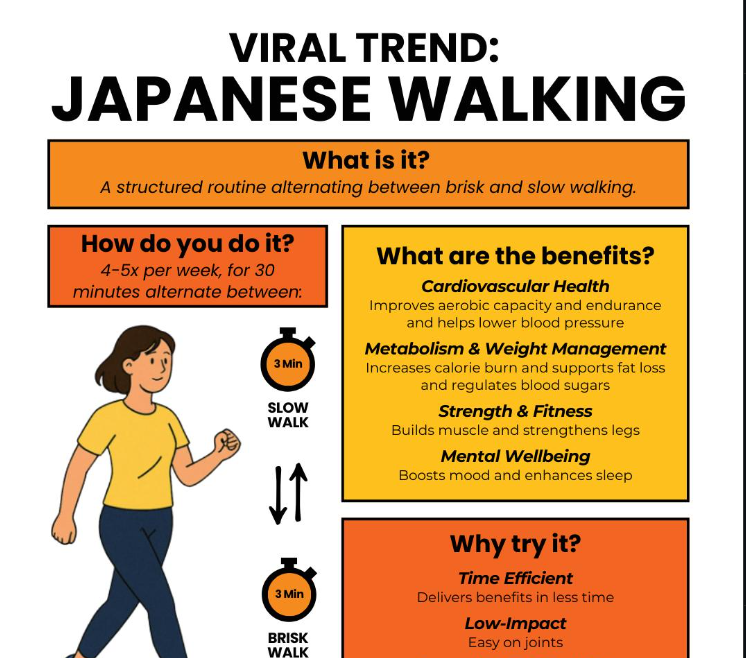
The concept is almost aggressively simple. Walk fast for 3 minutes. Walk slow for 3 minutes. Repeat five times for a total of 30 minutes. Do that four or more days per week. That’s the entire program — no gym, no equipment, no complicated periodization. Just two speeds.
What makes it interesting isn’t the simplicity. It’s what that simple alternation does to the body over time — and why it consistently outperforms steady-state walking in strength, cardiovascular fitness, blood pressure, and metabolic health across virtually every study that’s tested it.
💡 Japanese walking — officially known as Interval Walking Training (IWT) — was originally developed in Japan as a training intervention specifically for middle-aged and older adults to prevent lifestyle-related diseases. The fact that it’s now going viral globally is the research catching up with the internet.
What the Research Actually Shows
The original 2007 study, published in Mayo Clinic Proceedings, followed 246 adults with a mean age of 63. Participants were divided into three groups: no walking, moderate steady-pace walking targeting 8,000 steps, and interval walking training alternating fast and slow 3-minute blocks. Each group walked at least four times per week for five months.
The results weren’t marginal. The interval walking group significantly outperformed the steady-pace group across every physical fitness measure:
- Isometric knee extension increased by 13% — the steady-pace group saw no significant change
- Isometric knee flexion improved by 17% — directly relevant to fall prevention and stair climbing
- Peak aerobic capacity increased by 8–14% — a key longevity marker that most forms of steady cardio barely move
- Blood pressure reduced by an average of 10 points in men and 8 points in women — compared to 3 points in steady-pace walkers
🔬 A 2020 review by the original research team examined outcomes across 10,000 middle-aged and older adults who followed IWT programs. They found consistent improvements in blood pressure, blood glucose, BMI, triglycerides, and aerobic capacity — plus reductions in depression and improvements in sleep quality and cognitive function.
A 2025 follow-up study confirmed the same results in a new cohort, likely sparking the current viral wave. Participants showed improvements in resting blood pressure, lower-limb muscle strength, and VO2 max — the single strongest predictor of longevity in the exercise science literature.
Long-term follow-up data goes further still: people who maintained Japanese walking for 10 years preserved significantly more strength and aerobic capacity as they aged than those who didn’t — suggesting the benefits aren’t just short-term but genuinely compound over time, much like the daily habits that underpin long-term health.
Why Two Speeds Work Better Than One
The physiological reason Japanese walking outperforms regular walking comes down to intensity and recovery. When you push into a higher intensity — even for just 3 minutes — your heart rate climbs, blood flow to muscles increases, and your body begins the adaptations that build cardiovascular fitness and metabolic efficiency. The slow recovery period then allows you to sustain that effort repeatedly without the injury risk or burnout of sustained high-intensity training.
This mirrors the science behind HIIT (high-intensity interval training), but with one critical difference: the movement is walking. There’s no jumping, no running, no impact loading that puts ageing joints at risk. The intensity comes entirely from pace — which you control completely.
The fast intervals also trigger EPOC — excess post-exercise oxygen consumption — sometimes called the afterburn effect. Your body continues consuming more oxygen and burning more calories for hours after the walk ends, in a way that steady-state walking never produces. This is why interval walking burns significantly more calories than the same duration of regular walking, and why it has a measurable impact on blood sugar control that steady cardio doesn’t match.
💡 ‘In order to obtain improvements, we need to work at that higher level, but you can’t live in that high intensity all of the time — it’s not sustainable. Japanese walking allows you to push yourself during the higher intensity short bursts and then recover in real time.’ — Dennis Sluder, certified personal trainer
How to Do Japanese Walking — The Exact Protocol
The original protocol is straightforward:
- Fast walking — 3 minutes at roughly 70% of your maximum effort. This should feel like a 7 out of 10 — you can speak in short sentences but holding a full conversation feels challenging. Your breathing is noticeably elevated.
- Slow walking — 3 minutes at roughly 40% effort. This is a comfortable, easy pace — a 4 out of 10. You should be able to hold a full conversation and your breathing should recover.
- Repeat 5 times for a total of 30 minutes. Four or more days per week.
That’s the complete program. No warm-up phase required beyond the first slow interval. No equipment needed beyond supportive walking shoes and a timer or watch. A smartphone stopwatch works perfectly — or set a playlist with tracks that alternate slower and faster tempos to signal your intervals automatically.
How Hard Is 'Fast'?
A simple way to calculate your target fast-walking heart rate: subtract your age from 220, then multiply by 0.7. For a 45-year-old, that’s roughly 122 beats per minute. For a 65-year-old, around 108 bpm. If you don’t have a heart rate monitor, the talk test works just as well — fast walking should make conversation feel noticeably difficult but not impossible.
On a Treadmill?
Japanese walking translates perfectly to a treadmill — set your fast speed, then drop to your slow speed every 3 minutes. You can also combine it with incline walking for even greater cardiovascular and lower-body muscle stimulus. Increasing the incline during your fast intervals is one of the most effective ways to elevate intensity without increasing pace.
🚶 Start this week: Tomorrow’s walk: set a 3-minute timer on your phone. Walk briskly until it goes off, then drop to an easy pace for 3 minutes. Repeat 5 times. You’ve done your first Japanese walking session.
Who Japanese Walking Is For
One of the most significant findings from the original research is that almost anyone can do it. The intensity is relative to your own fitness level — a beginner’s fast pace might be a brisk stroll, while a fitter person might power walk at near-running speed. Both are doing Japanese walking correctly. Both get the benefits.
This makes it particularly well-suited to people returning to exercise after a long break, those managing joint pain or recovering from injury, and anyone who finds high-impact exercise intimidating or inaccessible. The low-impact nature means muscle soreness is minimal and the risk of injury is dramatically lower than running or gym-based HIIT.
It also works as a standalone program or as a cardio complement to resistance training — which addresses the muscle preservation and bone density gaps that cardio alone, including Japanese walking, cannot fully cover.
🔬 Ohio State University sports medicine expert Dr. Bryant Walrod: ‘IWT appears to provide more advantages than walking 8,000 steps a day at a steady moderate pace. In addition to improving cardiovascular fitness, burning more calories and boosting metabolism, research indicates that IWT can help prevent cognitive decline, diabetes, heart disease, and osteoporosis.’
The Full List of Research-Backed Benefits
- Cardiovascular fitness — VO2 max improvements of 8–14% over 5 months. Stronger heart, better oxygen delivery, lower resting heart rate
- Blood pressure reduction — average 10-point systolic reduction. More effective than steady-pace walking and comparable to some medications
- Leg strength — 13–17% improvements in knee extension and flexion. Directly reduces fall risk and supports daily independence
- Blood sugar control — muscles absorb glucose during the fast intervals, improving insulin sensitivity and metabolic health
- Weight management — burns more calories than steady walking via EPOC and higher intensity intervals
- Bone health — the varied loading from alternating intensities provides more bone stimulus than uniform steady walking
- Mental health — consistent improvements in mood, sleep quality, and reduced depression across multiple studies
- Cognitive protection — long-term IWT associated with reduced cognitive decline. Combined with anti-inflammatory nutrition, one of the most evidence-backed brain health habits available
Getting More From Japanese Walking
Japanese walking handles cardiovascular fitness, blood sugar control, and lower-body strength better than regular walking. To maximize those results, two nutritional factors compound the effect significantly.
The first is protein intake. The leg strength improvements IWT produces require adequate protein to build and repair muscle tissue. Without sufficient protein — particularly in the 1–2 hours following exercise — the training stimulus is partially wasted. The second is an anti-inflammatory diet that supports vascular health, reduces the chronic inflammation that impairs blood vessel function, and feeds the cardiovascular adaptations Japanese walking produces.
For the full picture on building these habits alongside your exercise routine, the 10 small daily habits guide shows exactly how post-meal walks, protein timing, and consistent movement stack into compound health gains over months.
Frequently Asked Questions
Is Japanese walking the same as HIIT?
It uses the same principles as HIIT — alternating high and low intensity — but at a much lower intensity ceiling. Running-based HIIT pushes to near-maximal effort; Japanese walking pushes to a brisk but sustainable pace. This makes it far more accessible to beginners, people with joint issues, and anyone who finds conventional HIIT intimidating or injury-prone.
How is it different from regular walking?
Regular walking maintains a steady pace — typically around 40–50% of your aerobic capacity. Japanese walking alternates between 40% (slow) and 70%+ (fast), which forces cardiovascular and muscular adaptations that steady walking simply doesn’t trigger. Think of it like the difference between driving at a constant 40mph versus accelerating and decelerating repeatedly — the engine works significantly harder over the same distance.
Can I do Japanese walking if I have bad knees or joint pain?
Yes — it’s one of the most joint-friendly forms of interval training available, because both the fast and slow phases are still walking, with both feet in contact with the ground at all times. If knee or hip pain is a concern, start with a very modest pace difference between your fast and slow intervals and build gradually. Walking on flat, smooth surfaces reduces joint loading further.
How soon will I see results?
The original research showed measurable improvements in blood pressure, aerobic capacity, and leg strength after 5 months of consistent practice at 4 days per week. Anecdotal reports suggest mood and energy improvements within the first 2–3 weeks. Like all compounding health habits, the results build slowly and then dramatically.
Can I do Japanese walking on a treadmill?
Absolutely — treadmills make the protocol easy to follow precisely. Set your fast speed, then drop to your slow speed every 3 minutes. Adding incline during the fast intervals increases the intensity without requiring a faster pace, making it ideal for people who want more cardiovascular challenge with less joint impact.
Should I combine Japanese walking with strength training?
Yes. Japanese walking handles cardiovascular fitness and lower-body endurance exceptionally well. It does not, however, provide sufficient resistance stimulus to meaningfully preserve muscle mass or bone density. Pairing Japanese walking with two resistance training sessions per week covers all the major bases of long-term physical health.
Is 30 minutes necessary or can I do less?
The original protocol is 30 minutes (5 cycles of 3+3 minutes). If that’s too much to start, 2–3 cycles of 12–18 minutes still provides meaningful cardiovascular stimulus. Consistency beats duration — three 15-minute sessions per week will produce better long-term results than one perfect 30-minute session.
The Short Version
Japanese walking — interval walking training — alternates 3 minutes of fast walking with 3 minutes of slow walking, repeated 5 times for 30 minutes, 4+ days per week. Two decades of research consistently shows it outperforms regular walking for:
- Cardiovascular fitness — VO2 max improvements of up to 14% over 5 months
- Leg strength — 13–17% gains in knee extension and flexion vs. no change in steady walkers
- Blood pressure — average 10-point systolic reduction vs. 3 points in regular walkers
- Blood sugar control — faster glucose absorption through working muscles during fast intervals
- Weight management — EPOC afterburn effect continues calorie burning after the walk ends
- Mental health and sleep — consistent improvements across all long-term studies
No gym. No equipment. No running. Just two speeds and a timer. Pair it with resistance training twice a week and the right nutritional foundation and you have one of the most complete, accessible fitness protocols available at any age.
Related reading:
- The 12-3-30 Treadmill Workout — Incline Walking to Pair With Japanese Walking
- Top 5 Ways to Reduce Joint Pain Without Medication — Keep Walking Pain-Free
- Seated Resistance Band Exercises — The Strength Training That Completes the Picture
- The Best Protein Sources — Fuel the Muscle Your Walks Are Building
- 5 Foods to Eat Every Day — Anti-Inflammatory Nutrition for Better Cardiovascular Health
- 10 Small Daily Habits That Compound Into Major Health Gains
- Sarcopenia — Why Walking Alone Isn’t Enough to Stop Muscle Loss
- Top 5 Exercises Seniors Should STOP Doing — And What to Do Instead
⚠️ Medical Disclaimer: This article is for informational and educational purposes only and does not constitute medical advice. Consult your physician before beginning any new exercise program, particularly if you have a cardiovascular condition, joint replacement, diabetes, or other chronic health condition.