Here’s a frustrating truth: a lot of the exercise advice circulating in gyms, physical therapy clinics, and wellness blogs was designed for younger bodies and never properly updated for the realities of aging joints, reduced bone density, compressed spinal discs, and the diminished recovery capacity that comes with getting older.
That doesn’t mean seniors should exercise less. The research is unambiguous — regular exercise is one of the most powerful longevity interventions available to adults over 60, dramatically reducing the risk of cardiovascular disease, cognitive decline, sarcopenia, and fall-related injury. The question isn’t whether to exercise. It’s which exercises give you the benefits without putting you at unnecessary risk.
The five exercises below appear on virtually every senior fitness watch list — and they keep injuring seniors because the warning isn’t reaching the people who need it. More importantly, each one has a safer, equally effective alternative that delivers the same training benefit without the risk. Stopping these five movements won’t set your fitness back. Switching to the alternatives will move it forward.
💡 A 2021 international consensus report from the ICFSR — drawing on the work of exercise scientists across dozens of institutions — confirmed that exercise programming for older adults must account for age-related changes in spinal integrity, joint health, balance, and bone density. Exercises designed for younger populations are not automatically appropriate for adults over 60.
1. 🔙 Sit-Ups and Crunches — The back injury hiding in plain sight
❌ STOP DOING: Sit-Ups and Crunches | ✅ DO THIS INSTEAD: Dead Bug, Bird Dog, or Seated Core Press |
Crunches and sit-ups are the most commonly recommended core exercises in the world — and one of the most problematic for seniors. The movement requires repeated spinal flexion under load, compressing the intervertebral discs in the lumbar spine with each repetition. For younger adults with healthy, hydrated discs, this is manageable. For seniors — whose discs have lost significant water content and structural integrity over decades — repeated spinal flexion is a reliable pathway to disc herniation, nerve compression, and chronic lower back pain.
Back specialist and spinal biomechanics researcher Stuart McGill, Ph.D., has spent decades studying the mechanical forces of common exercises on the spine. His research identifies traditional sit-ups and crunches as among the highest-risk exercises for spinal compression injury — with the risk escalating significantly in older adults.
What to do instead: Dead Bug
The Dead Bug is the gold-standard core exercise for seniors. Lying on your back with arms extended to the ceiling and knees at 90 degrees, you slowly lower opposite arm and leg toward the floor while maintaining a neutral spine. The exercise builds deep core stability — the kind that protects your back in real life — without spinal flexion or disc compression. It is used in elite sports rehabilitation and senior fall prevention programs alike.
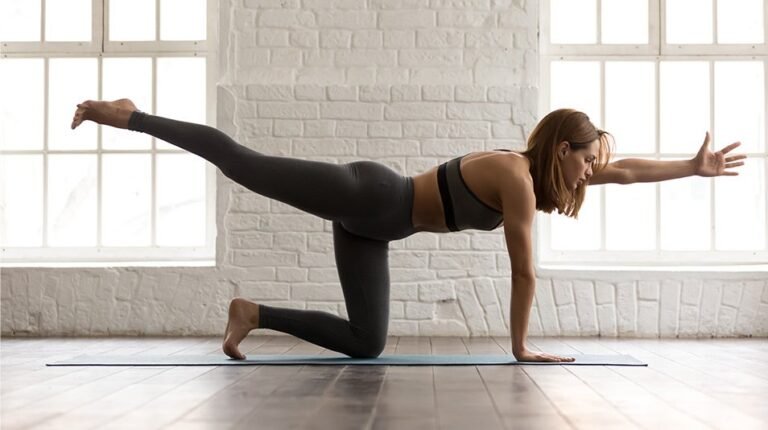
Or try: Bird Dog
From a hands-and-knees position (or modified on a chair), extend opposite arm and leg while keeping the spine completely neutral. Trains the same deep stabilisers as Dead Bug with even lower spinal load. See our seated resistance band exercise guide for a chair-based version requiring zero floor work.
2. 🏋️ Behind-the-Neck Lat Pulldowns and Shoulder Press — Your rotator cuff is not built for this angle
❌ STOP DOING: Behind-the-Neck Pulldowns / Press | ✅ DO THIS INSTEAD: Front-of-Face Lat Pulldown or Seated Dumbbell Press |
The behind-the-neck lat pulldown — where the bar passes behind the head to the upper traps — was standard gym practice for decades. So was the behind-the-neck overhead press. Both have largely fallen out of favor in modern exercise science, and for good reason: pulling or pressing a load behind the neck places the shoulder joint in extreme external rotation while under resistance, a position the rotator cuff is not designed to sustain, especially in aging shoulders with reduced tendon elasticity and joint space.
Common injuries include rotator cuff tears, cervical spine strain, and acromioclavicular impingement. The American Academy of Orthopaedic Surgeons notes that rotator cuff injuries become dramatically more common after 60 — and recovery from a tear in an older adult is significantly more difficult and prolonged than in younger patients. This is an injury worth preventing.
⚠️ If you have already been diagnosed with any shoulder impingement, rotator cuff weakness, or cervical disc issues — behind-the-neck movements are contraindicated regardless of age. Stop immediately if you experience any shoulder clicking, pinching, or pain during overhead movements.
What to do instead: Front-of-Face Lat Pulldown
Pulling the bar to the front of the chest — collarbone level — produces identical lat activation to the behind-the-neck version with none of the rotator cuff stress. You get the same back-building benefit in a completely safe shoulder position. Seated rows with a resistance band are an equally excellent alternative for seniors without gym access.
3. 🦵 Full Deep Squats with Heavy Weight — The knee and hip load that's doing more harm than good
❌ STOP DOING: Heavy Weighted Deep Squats | ✅ DO THIS INSTEAD: Box Squat, Wall Sit, or Sit-to-Stand |
Squatting is a fundamental human movement pattern — and seniors should squat. The sit-to-stand motion alone is one of the most functional and important movements for maintaining independence in daily life. The problem isn’t squatting. The problem is adding heavy external load to a deep squat in a body managing arthritic knees, reduced hip mobility, or compromised spinal integrity.
Deep weighted squats require significant ankle dorsiflexion, hip mobility, and knee joint integrity — all of which decline with age. When these ranges aren’t fully available, the body compensates by shifting load to the lumbar spine, rounding forward, and placing shear stress on the knee joint in positions it cannot safely support under load. The result is accelerated joint wear and a high risk of acute injury — particularly for seniors with existing knee or hip conditions.
The same holds true for heavy leg press machines pushed to deep ranges of knee flexion — another commonly prescribed exercise that places enormous compressive and shear force on the knee at the bottom of the movement.
What to do instead: Box Squat or Sit-to-Stand
A box squat — squatting to a chair or box that stops the movement at a safe range — provides all the functional benefit of squatting while eliminating the problematic depth. The sit-to-stand movement (standing up from and sitting down into a chair, slowly and with control) is the purest, most functional version of this pattern available. Done for 3 sets of 10 with a 3-second lowering phase, it directly trains the movement of daily life without any equipment or injury risk.
For seniors who want progressive challenge, wall sits build leg strength isometrically with zero knee shear. Our full chair workout program includes multiple safe squat-pattern variations built specifically for this.
4. 💨 High-Impact Cardio and Running on Hard Surfaces — The cardio your joints are paying for
❌ STOP DOING: Running / High-Impact Aerobics | ✅ DO THIS INSTEAD: Incline Walking, Water Aerobics, or Cycling |
Running delivers tremendous cardiovascular benefit — but ground reaction forces during running are 2–3 times body weight with every stride. For a 160-pound senior, that’s 320–480 pounds of force transmitted through ankles, knees, hips, and lumbar spine with every footfall. Young, healthy joints with thick cartilage and elastic tendons can absorb this. Aging joints — with thinner cartilage, stiffer tendons, and potentially osteoporotic bone — increasingly cannot.
High-impact aerobics classes carry similar risks: jumping, fast directional changes, and repetitive impact on hard floors create fall risk, joint stress, and a pattern of microtrauma that accumulates faster than older tissue can repair. Most group fitness classes are designed for younger bodies and simply haven’t been adapted for the senior population who shows up and participates.
This doesn’t mean seniors can’t do cardio. It means they should choose cardiovascular exercise that raises heart rate without loading joints through impact.
What to do instead: Incline Walking
The 12-3-30 incline treadmill method — walking at an incline — produces cardiovascular intensity comparable to jogging while keeping both feet on the belt at all times. A 2018 ACE study found incline walking burns significantly more calories than flat walking at the same speed, with dramatically lower joint impact. For seniors who want to get their heart rate up without the pounding, incline walking is the closest thing to a perfect cardio solution.
Or try: Water Aerobics or Cycling
Water exercise offloads up to 90% of body weight through buoyancy, eliminating virtually all joint impact while still providing cardiovascular and resistance training benefits. Stationary cycling similarly provides vigorous cardiovascular conditioning with minimal joint load. Both are excellent primary cardio options for seniors managing knee, hip, or ankle conditions.
5. 🧘 Unsupported Toe Touches and Deep Forward Bends — The hamstring stretch that's straining your spine
❌ STOP DOING: Standing Toe Touches / Unsupported Forward Bends | ✅ DO THIS INSTEAD: Seated Hamstring Stretch or Supine Single-Leg Stretch |
The classic standing toe touch — bending forward from standing to reach the floor — is one of the most reflexively common stretches performed by adults of every age. It feels natural, it’s culturally ingrained, and it does provide a hamstring stretch. It also places the lumbar spine in full flexion under the weight of the upper body, loading the very spinal structures — discs, facet joints, and spinal ligaments — most likely to be compromised in older adults.
Seniors with existing lumbar disc issues, spinal stenosis, or osteoporosis are at particular risk. But even seniors without a known diagnosis may be unknowingly stressing discs that have lost structural integrity without obvious pain — until one repetition too many crosses the threshold into acute injury. The lower back is the single most common site of pain and injury in adults over 60, and unsupported forward bending under body weight is a primary contributor.
The same risk applies to seated forward reaches in yoga and stretching classes where the pelvis tilts backward and the lumbar spine rounds — a position that again loads the posterior disc under stretch.
What to do instead: Seated Hamstring Stretch (Supported)
Sitting in a firm chair, extend one leg forward and gently lean forward from the hips — not the waist — keeping the spine as neutral as possible. This stretches the hamstring without loading the lumbar spine through its full flexion range. Holding a towel or strap around the foot while lying on your back (supine single-leg stretch) is even safer and equally effective at lengthening the hamstrings without any spinal loading.
💡 A useful rule of thumb for seniors: if a stretch or exercise requires your lower back to round significantly under load or gravity — whether that’s a forward bend, a crunch, or a deep squat — treat it with caution. A neutral spine (its natural slight curve maintained) is almost always the safer position for aging spinal structures.
The Senior Exercise Substitution Guide — At a Glance
- Crunches / Sit-ups → Dead Bug, Bird Dog, Seated Core Press
- Behind-the-neck pulldowns / press → Front-of-chest lat pulldown, Seated row
- Heavy deep squats → Box squat, Sit-to-stand, Wall sit
- Running / high-impact aerobics → Incline treadmill walking, water aerobics, cycling
- Standing toe touches → Supported seated hamstring stretch, Supine strap stretch
None of these substitutions mean exercising less. They mean exercising smarter — targeting the same muscles and energy systems through movements your body can sustain safely for years to come. The goal is a fitness practice that compounds over decades, not one that takes you out for months with a preventable injury.
What Seniors SHOULD Be Doing — The Research-Backed Short List
Replacing these five movements leaves a gap worth filling with the exercises that actually deliver results for older adults. The 2021 ICFSR international consensus recommends seniors prioritize:
- Resistance training 2–3 times per week: Targeting all major muscle groups through safe, joint-friendly movements. Seated resistance band exercises and chair workouts are where to start
- Low-impact cardio 3–5 times per week: Incline walking, cycling, swimming, or water aerobics for 20–40 minutes. The 12-3-30 method is an ideal entry point
- Balance training daily: Single-leg standing, heel-to-toe walking, and simple stability drills. Thirty seconds per side, near a wall or counter. This is the exercise with the most direct impact on fall prevention
- Flexibility work 3–5 times per week: Gentle, supported stretching — particularly for hips, hamstrings, and thoracic spine. Always in a supported, spinal-neutral position
The full framework for building this into a consistent routine is in our 10 Small Daily Habits guide — which shows how 10-minute resistance sessions, post-meal walks, and daily balance work stack into genuine transformation over months.
Frequently Asked Questions
Are these exercises dangerous for every senior?
Risk is individual. A highly conditioned 65-year-old with no spinal or joint issues may tolerate some of these movements better than a sedentary 62-year-old with disc problems. The list above reflects elevated risk for the average senior — not an absolute prohibition for every person. If you’re uncertain about any exercise, consult a physiotherapist or exercise professional who specializes in senior populations before continuing.
My doctor / physio recommended one of these exercises. Should I stop?
Have a conversation before stopping. There may be a specific reason your provider chose a particular exercise for your individual situation. Bring this article and ask directly: given my age and condition, are there safer alternatives that achieve the same goal? Most good clinicians welcome this kind of informed question.
What if I've been doing these exercises for years without problems?
The absence of pain doesn’t mean the absence of cumulative load on spinal discs and joint cartilage. Many disc and joint injuries in seniors are the product of years of accumulated stress that doesn’t become symptomatic until a threshold is crossed. If you’ve been doing these movements pain-free, that’s positive — but it’s still worth transitioning to safer alternatives before that threshold is reached, not after.
Is it ever safe for seniors to run?
For seniors with good bone density, healthy joints, strong connective tissue, and a long running history — moderate running can be appropriate. The risk profile is very different for a lifelong runner in their 60s versus someone returning to running after years of inactivity. The concern is primarily for seniors with arthritic knees, low bone density, recent joint surgery, or no recent running history who are considering taking it up. If that’s you — start with incline walking and build from there.
The Bottom Line
Stopping these five exercises won’t hold your fitness back. The alternatives are equally effective, meaningfully safer, and better suited to how your body actually works after 60. Exercise should be the thing that keeps you independent, strong, and mobile for decades — not the thing that puts you in recovery for months.
Build the right foundation from here:
- Seated Resistance Band Exercises for Seniors — Safe Strength Training That Works
- Chair Workouts for Seniors — The Complete Program
- The 12-3-30 Treadmill Workout — Low-Impact Cardio Seniors Actually Love
- What Is Sarcopenia? Why the Right Exercises Matter More Than Most Seniors Know
- 10 Small Daily Habits That Compound Into Major Health Gains After 60
- Exercise After Hip Replacement — The Safe, Week-by-Week Recovery Guide
⚠️ Medical Disclaimer: This article is for informational and educational purposes only and does not constitute medical advice. Exercise suitability varies significantly based on individual health conditions, fitness history, and medical circumstances. Always consult your physician or a qualified physiotherapist before beginning or modifying an exercise program, particularly if you have a history of back pain, joint surgery, osteoporosis, or cardiovascular conditions.