| 🚶 Activity Level | 📊 Daily Steps | 👤 Best For | ✅ Key Health Benefits | 💡 Tip |
|---|---|---|---|---|
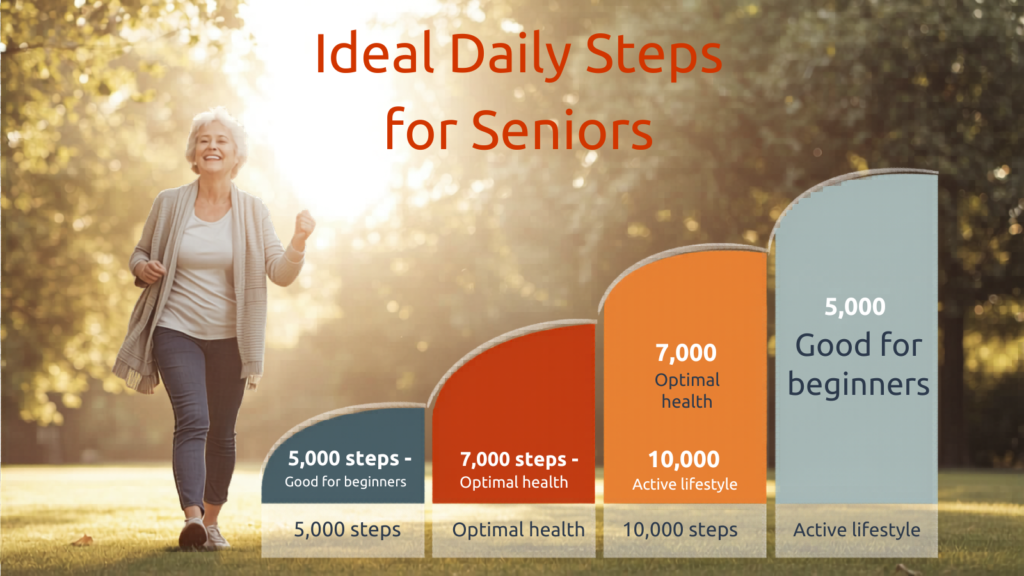
| Getting Started | 2,000–4,000 | Very sedentary seniors or those with limited mobility | Health benefits begin. Meaningful improvement over no regular movement. | Add 500 steps per week until reaching 4,000 |
| Good Foundation | 4,000–5,999 | Seniors building a walking habit | Significant mortality risk reduction begins. Joint lubrication. Mood improvement. | Two 15-minute walks per day reaches this range |
| 🎯 Target Zone | 6,000–8,000 | Most seniors over 60 — evidence-backed target | Near-maximum benefit: 47% lower mortality risk, 60% reduction in cognitive decline, fall prevention, metabolic health | Two 30-min walks = ~5,000–6,000 steps at a comfortable pace |
| High Activity | 8,000–10,000 | Active seniors without mobility limitations | Continued benefit — especially for weight management. Minimal additional mortality benefit over 8,000. | Add Japanese walking intervals for extra cardiovascular benefit |
| Beyond 10,000 | 10,000+ | Very active seniors — optional | Not harmful. Minimal additional longevity benefit beyond 8,000 for seniors. May aid weight management. | Focus on pace quality rather than pure step count at this level |
Sources: The Lancet Public Health (2025) · Healthline meta-analysis (March 2026) · SilverSneakers (2026) · Epidemiologia — Spanish cohort 668 adults 60–100 (2026) · PMC 15-study meta-analysis (2022) | Every additional 1,000 steps/day reduces cardiovascular disease risk and all-cause mortality

Most seniors have heard the same advice: walk 10,000 steps a day.
It sounds straightforward. But here is the problem — the 10,000-step goal was never based on medical research. It came from a Japanese marketing campaign for a pedometer in 1965.
Since then, researchers have spent decades studying exactly how many steps actually improve health, reduce mortality, and protect independence in older adults.
The answer is both simpler and more encouraging than most people expect.
Where Did the 10,000-Step Rule Come From?
The number 10,000 was chosen because the Japanese character for 10,000 (万) looks like a person walking. It was a marketing decision, not a scientific one.
For decades, this number spread across fitness apps, smartwatches, and public health messaging — despite having no specific research behind it for older adults.
That changed when large-scale studies started tracking exactly what happens to health outcomes at different step counts. What they found surprised even the researchers.
What the Research Actually Says for Seniors Over 60
A 2025 systematic review published in The Lancet analyzed daily steps and health outcomes across multiple large cohort studies. The findings were clear.
For adults over 60, health benefits begin at just 4,000 steps per day. They increase steadily up to around 6,000 to 8,000 steps — and then the curve levels off significantly.
A separate 2025 review found that taking 7,000 steps daily was associated with a 47% lower risk of all-cause mortality compared with 2,000 steps.
Perhaps most importantly: a 2022 meta-analysis of 15 international cohort studies confirmed that the mortality benefit plateau for older adults occurs well below 10,000 — typically between 6,000 and 8,000 steps.
Walking more than that is not harmful. But you do not need to reach 10,000 steps to get near-maximum health benefit as a senior.
The Real Target: 6,000 to 8,000 Steps Per Day
Based on the most current research, the evidence-backed daily step target for seniors over 60 is 6,000 to 8,000 steps per day.
A 2026 Spanish study tracking 668 adults aged 60 to 100 found that 7,000 steps per day was associated with a 60% reduction in subjective cognitive decline. The same study found that consistent daily walking — even at lower intensities — protected against depression and chronic pain.
SilverSneakers, citing multiple peer-reviewed sources, confirmed in 2026 that 6,000 to 8,000 steps per day provides meaningful benefits for heart health, mobility, and longevity in older adults.
For seniors with limited mobility, research suggests that even 4,600 steps per day produces significant health improvements compared to being largely sedentary. Every additional 1,000 steps per day further reduces cardiovascular disease risk and all-cause mortality.
Why Walking Speed Matters as Much as Step Count
Step count alone does not tell the full story. Research consistently shows that walking speed is an independent predictor of health outcomes in older adults — sometimes more powerfully than total step count.
A brisk pace that slightly elevates your breathing activates Zone 2 cardio — the intensity range where the body preferentially burns fat and produces the strongest cardiovascular adaptations. This is the zone where your heart and lungs are challenged enough to improve, but you can still hold a conversation.
The Japanese walking method — alternating 3 minutes of brisk walking with 3 minutes of slower walking — takes advantage of exactly this principle. It produces significantly greater cardiovascular benefit than walking at one steady pace throughout.
You do not need to walk fast the entire time. Even mixing brief periods of brisker walking into your daily steps meaningfully improves the health return on every mile you cover.
What Counts Toward Your Daily Step Total?
One of the most encouraging findings from the research is that all steps count. Not just formal exercise walks.
Steps taken while cooking, doing laundry, walking to the mailbox, moving around the house, or going from the car to the store all add up toward your daily total — and they all contribute to the health benefits.
This means a senior who takes three 10-minute walks during the day, moves around normally at home, and runs a few errands may already be at 5,000 steps without a dedicated exercise session.
Building toward 6,000 to 8,000 steps is often more achievable than people expect once they start tracking. The key is consistency across the day rather than cramming all movement into a single long session.
Short, frequent movement breaks — like those in the micro workout approach for seniors — are particularly effective at accumulating steps while also addressing the prolonged sitting time that independently raises health risk.
How to Build Up to Your Target If You Are Starting Low
If you are currently taking fewer than 3,000 steps per day, trying to reach 7,000 overnight is not the right approach.
Researchers and physical therapists both recommend adding 500 to 1,000 steps per week to your current baseline. This allows your body — joints, tendons, cardiovascular system — to adapt progressively without injury.
A simple four-week ramp-up looks like this:
- Week 1: Add one 10-minute walk per day
- Week 2: Extend to two 10-minute walks per day
- Week 3: Extend one walk to 15–20 minutes
- Week 4: Aim for 30 minutes total across the day in any combination
The right footwear makes this easier and safer. Proper walking shoes for seniors with non-slip soles, good cushioning, and a wide toe box reduce the joint stress that stops many seniors from building their step count consistently.
If joint pain is limiting your walking distance, address the pain first. Many seniors find that simple daily movement — even short walks — reduces chronic joint discomfort within two to three weeks.
The Benefits Seniors Actually Notice From Daily Walking
The research on step count and health outcomes in older adults covers a wide range of benefits. Here are the most significant ones.
- Lower Mortality Risk
Walking 7,000 steps daily is associated with a 47% lower risk of all-cause mortality compared with walking 2,000 steps — a reduction that holds regardless of age, sex, or body weight.
- Reduced Fall Risk
Daily walking builds the leg strength, balance, and ankle proprioception that directly reduce fall risk. This is the same system trained by functional fitness exercises and one of the most important factors for maintaining independence after 60.
- Better Cognitive Health
The 2026 Spanish study found that 7,000 daily steps was associated with a 60% reduction in subjective cognitive decline. Regular walking increases blood flow to the brain and supports the hippocampal health that underlies memory and executive function.
- Improved Mood
Consistent daily walking reduces symptoms of depression and anxiety through endorphin release, cortisol reduction, and social engagement. Accumulating 7,000 or more steps per day was found to provide the greatest protection against depressive symptoms in older adults.
- Stronger Joints
Regular low-impact walking lubricates joints by stimulating synovial fluid circulation — directly reducing the morning stiffness that limits movement. This is the opposite of what many seniors fear: walking is medicine for arthritic joints, not a threat to them.
- Better Metabolic Health
Each additional 1,000 steps per day improves insulin sensitivity and reduces cardiovascular disease risk. Walking after meals — even 10 minutes — produces a significant reduction in post-meal blood sugar. Pair this with an anti-inflammatory diet and the metabolic benefits compound significantly.
Walking vs. Other Exercise: Does It Replace Strength Training?
This is one of the most important questions for seniors to understand correctly.
Walking is excellent for cardiovascular health, cognitive function, mood, and metabolic health. But it does not prevent or reverse sarcopenia — age-related muscle loss.
Muscle loss after 60 is the primary driver of frailty, slow metabolism, and loss of independence. Only resistance training provides the progressive overload signal that preserves and rebuilds muscle tissue.
The most effective approach combines both: daily walking for cardiovascular and metabolic health, plus two to three resistance training sessions per week for muscle preservation. If time is limited, even brief 5-minute micro strength sessions done consistently provide meaningful benefit.
For a detailed look at whether walking alone is sufficient, see our guide: Is walking enough exercise after 60?
Frequently Asked Questions
Is 10,000 steps a day too much for a 70-year-old?
Not too much, but more than necessary for maximum health benefit. Research shows that health benefits for seniors plateau at around 6,000 to 8,000 steps. Walking more is fine if it feels good, but there is no evidence it provides additional mortality benefit beyond 8,000 steps for older adults.
What is a good daily step count for a 65-year-old?
A target of 6,000 to 8,000 steps per day is evidence-backed for adults over 60. Start wherever you are and add 500 to 1,000 steps per week. Even reaching 5,000 steps consistently produces significant health improvements over a sedentary baseline.
How many steps is a 30-minute walk for a senior?
A comfortable senior walking pace of around 2 to 2.5 mph produces approximately 2,500 to 3,000 steps in 30 minutes. Two 30-minute walks per day would comfortably reach the 6,000-step target while aligning with the daily movement habits most associated with longevity.
Does walking speed matter more than step count?
Both matter, but they work differently. Step count predicts overall activity level and correlates with mortality outcomes. Walking speed independently predicts cardiovascular fitness and functional capacity. Mixing brisk and slower intervals — as in the Japanese walking method — maximizes both metrics simultaneously.
Can I split my steps into smaller walks throughout the day?
Yes — and this is actually encouraged. Three 10-minute walks produce the same or greater health benefit as one 30-minute walk. Multiple shorter sessions also reduce the prolonged sitting time that independently raises cardiovascular and metabolic risk. The step total is what matters, not how it is accumulated.
What if I have joint pain that makes walking difficult?
Start shorter and focus on comfortable, pain-free movement. Even 10 minutes twice a day is a meaningful starting point. Supportive walking shoes reduce joint stress significantly. Many seniors find that consistent gentle walking actually reduces chronic joint pain within two to three weeks by stimulating synovial fluid circulation.
Do steps on a treadmill count the same as outdoor steps?
Yes — treadmill steps count equally toward your daily total. The 12-3-30 incline treadmill method is one of the most research-backed indoor walking approaches for seniors, providing Zone 2 cardiovascular intensity while eliminating outdoor fall risk and weather barriers.
Conclusion
The 10,000-step rule is a marketing myth. For seniors over 60, the research is clear: 6,000 to 8,000 steps per day is where near-maximum health benefit occurs.
Start where you are. Add 500 to 1,000 steps per week. Wear the right shoes, break your walking into sessions, and mix in brief periods of brisker pace when comfortable.
Pair daily walking with the longevity habits and 5 daily foods that the research most consistently associates with health in your 70s, 80s, and beyond — and walking becomes one part of a compounding system, not just a number to hit each day.
Every step counts. Start today.