| Level | ⚖️ Exercise | ⏱️ Duration | 📊 Difficulty | ✅ What It Trains | 📍 Where to Do It |
|---|---|---|---|---|---|
| 1 BEGINNER | Two-Foot Stance Hold | 30 sec × 2 | ★☆☆☆☆ | Ankle stabilisers, static balance baseline | Counter or wall — one finger touch allowed |
| 2 CORE | Single-Leg Stand 🦵 | 30 sec each × 2 | ★★☆☆☆ | The walking balance pattern — most critical fall prevention exercise | Near counter. Goal: 30 sec hands-free |
| 3 | Heel-to-Toe Walking 👣 | 10 steps × 2 | ★★★☆☆ | Dynamic balance during movement — where most falls actually happen | Along a hallway wall |
| 4 | Clock Reach 🕐 | 4 positions × 2 | ★★★★☆ | Reactive balance — the split-second responses that catch stumbles | Near counter for safety |
| 5 ADVANCED | Tandem Stance + Arm Move 🏆 | 30 sec each × 2 | ★★★★★ | Dual-task balance — maintaining stability while doing something else | Near counter — progress to freestanding |
| 💡 | Daily habit | 90 sec/day | Every day | Thread into teeth brushing, waiting for kettle, TV commercials | No dedicated session needed |
Start at Level 1 regardless of fitness. Progress when 30 seconds feels easy. | Sources: British Journal of Sports Medicine (2021) · Cochrane Review (2021)
The first three parts of this series gave you the why behind micro workouts for seniors, a 5-minute morning routine, and a 5-minute strength session. Part 4 is the shortest and arguably the most important. It closes the gap that walking, strength training, and cardio all leave open: balance.
More than one in four adults over 65 falls each year. Half of those who fall do so again within a year. The consequences — hip fractures, head injuries, loss of independence, fear of movement — are devastating and frequently permanent. And yet balance is a trainable physical skill. It responds to practice. It improves at any age. And it requires as little as 90 seconds per day to make a meaningful difference.
🔬 British Journal of Sports Medicine: Adults who could not balance on one leg for 10 seconds had an 84% higher risk of all-cause mortality over a 7-year follow-up, independent of age, sex, BMI, and other health factors. Balance is not a vanity metric — it is one of the strongest physical predictors of how long and how well you live.
Why Balance Declines — and Why It's Reversible
Balance depends on three systems: vision, the vestibular system (inner ear), and proprioception — the network of sensors in your muscles, joints, and feet that tell your brain where your body is in space. All three decline with age, but proprioception declines fastest — and it responds most directly to targeted training.
Every time you practice a balance exercise, you are literally rebuilding the neural pathways that coordinate these systems. Studies show measurable improvements in balance and fall prevention within 4–6 weeks of consistent practice — even in adults who have already fallen.
💡 A 2021 Cochrane review found that tai chi — essentially formalized balance training — reduced fall risk in seniors by up to 31%. The exercises in this guide produce the same neuromuscular stimulus through simpler movements you can do at home in under 2 minutes.
The Balance Micro Workout — 5 Exercises, Progressive Difficulty
Equipment: A sturdy chair, kitchen counter, or wall for safety. Always have a stable surface within arm’s reach when starting out.
Level 1 — Two-Foot Stance Hold (Beginner) ⚖️
Stand with both feet together — heels touching, toes touching — with one hand resting lightly on a counter. Hold for 30 seconds. This sounds trivially easy. For many seniors, feet-together standing on a firm surface is genuinely challenging because it eliminates the wide base of support that compensates for poor proprioception.
- Duration: 30 seconds × 2 sets
- Progress: Lift fingertips off the counter, then remove hand entirely
Level 2 — Single-Leg Stand (Core Exercise) 🦵
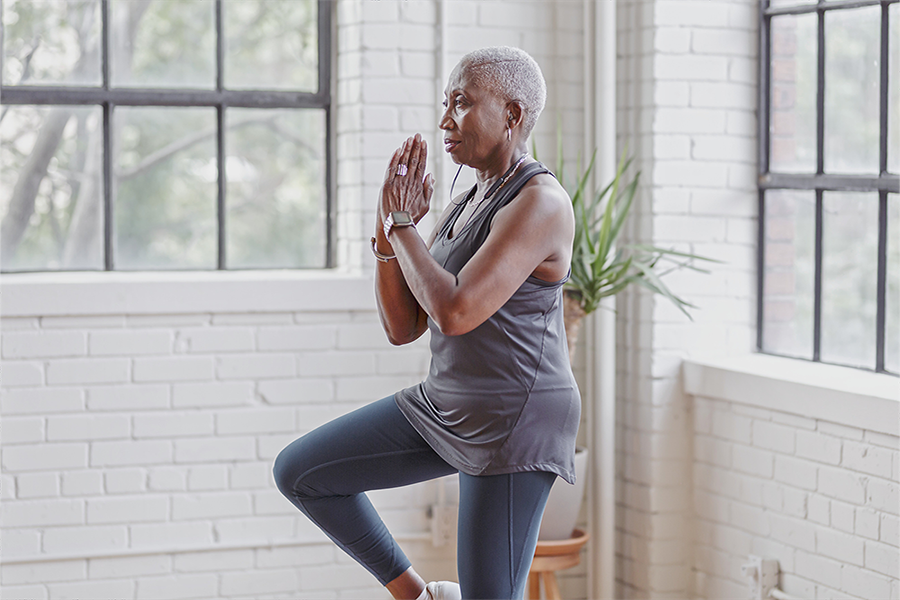
Stand near a counter. Lift one foot one inch off the floor. Hold 10–30 seconds. Switch sides. This is the exercise referenced in the British Journal of Sports Medicine mortality study. It directly trains the single-leg balance required for every step of walking. The goal is 30 seconds each side without touching down.
- Duration: 30 sec each side × 2 sets
- Progress: Eyes closed. Standing on a folded towel. Counting backwards from 20 while balancing (dual-task training).
- Why it matters: Single-leg stance duration is the strongest single-movement predictor of fall risk available
Level 3 — Heel-to-Toe Walking (Dynamic Balance) 👣
Walk in a straight line placing the heel of the front foot directly against the toe of the back foot with each step — like walking a tightrope. Do 10 steps, turn, return. This trains dynamic balance — balance during movement — which is the form that actually prevents falls, since most falls occur during walking, turning, or transitions between positions rather than while standing still.
- Duration: 10 steps forward, 10 steps back × 2 sets
- Safety: Do this along a wall or hallway so a handhold is always within reach
Level 4 — Clock Reach (Advanced Proprioception) 🕐
Stand on one leg. Imagine a clock face on the floor around you. Reach the lifted foot forward to 12 o’clock, then 3 o’clock, 6 o’clock, 9 o’clock — tapping the floor lightly at each position without putting the foot fully down between taps. This trains the reactive neuromuscular responses that catch you when you stumble — the ankle and hip stability that fires in the fraction of a second between a trip and a fall.
- Duration: 4 clock positions per leg × 2 sets
- Progress: 8 positions. Faster transitions. Eyes closed.
Level 5 — Tandem Stance with Arm Movement (Challenge) 🏆
Stand with one foot directly in front of the other (heel to toe). Hold for 30 seconds. Then add slow arm raises out to the sides while maintaining position. This trains the ability to maintain balance while simultaneously doing something else — the dual-task balance that fails when a senior reaches for a shelf, turns to answer someone, or carries shopping while walking.
- Duration: 30 sec each leg forward × 2 sets
✅ Start today: Stand near your kitchen counter. Lift one foot one inch off the floor. Hold as long as you can. Switch sides. Time yourself. Do this twice a day — morning and evening. Track your progress weekly.
How to Thread Balance Training Into Daily Life
- Brushing teeth — single-leg stand for the full 2 minutes. Switch legs halfway.
- Waiting for the kettle — tandem stance or heel raises while standing at the counter.
- During TV commercials — clock reach or heel-to-toe walking across the room.
- After the morning routine — 60 seconds of single-leg standing as the final exercise of your morning micro workout.
- Before each strength session — 60 seconds of two-foot stance or single-leg as a warm-up to your strength micro workout.
Frequently Asked Questions
How quickly does balance improve with training?
Most seniors notice measurable improvement within 3–4 weeks of daily practice. The single-leg hold duration increases faster than people expect. The broader fall prevention benefits — reduced stumbling, more confident stair climbing, steadier walking on uneven surfaces — typically manifest within 6–8 weeks.
What if I can't even stand on one leg at all?
Start with Level 1 — two-foot stance with feet together, hand on counter. Balance is a skill, not a fixed capacity. Everyone who practices it improves. Consistency matters more than starting ability.
Is balance training safe for seniors who have already fallen?
Yes — and it’s particularly important for this group. These exercises are designed to be done with support nearby, making them safe for seniors with a fall history. Always consult your physician if you have had a recent fall involving injury.
How does this complete the micro workout series?
This series now gives you a complete daily micro workout system: the morning routine every day, the strength session three times per week, and balance training threaded through the day continuously. Total dedicated time: 10–15 minutes per day. Total impact: covers all four pillars of senior fitness — cardiovascular health, muscle strength, bone stimulus, and balance.
The Short Version — Your Complete Micro Workout Series
- Part 1: The science — why micro workouts work, the 4 types, how to build the habit
- Part 2: Morning routine — 5 minutes in/beside bed before your first steps
- Part 3: Strength session — 5 minutes, resistance band, 3x per week
- Part 4 (this post): Balance training — 90 seconds woven into daily life, every day
Practice daily. Start at whichever level challenges you. Your future self — walking confidently and independently at 80 — is built one 90-second balance session at a time. Pair with the other longevity habits for the complete picture.
📌 Complete series:
- Part 1: Micro Workouts for Seniors — Why 5 Minutes Is All You Need — se7ensymbols.com
- Part 2: The 5-Minute Senior Morning Micro Workout — se7ensymbols.com
- Part 3: Micro Workouts for Seniors — The 5-Minute Strength Session — se7ensymbols.com
- Part 4: This post — update slug after publishing
Related Reading:
Related reading:
- Micro Workouts for Seniors Part 1 — The Foundation
- Micro Workouts for Seniors Part 2 — The Morning Routine
- Micro Workouts for Seniors Part 3 — The Strength Session
- Top 5 Exercises Seniors Should STOP — Safe Balance Alternatives
- Functional Fitness for Seniors — The Training Style That Keeps You Independent Longer
- Why Sarcopenia Is the Greatest Threat to Senior Independence
- The 12-3-30 Treadmill Workout — Pair With Balance Training for Complete Senior Fitness
- 10 Small Daily Habits That Compound Into Major Health Gains After 60
- The 7 Longevity Habits of People Who Stay Healthy Into Their 80s