| 🧠 Memory Issue | ✅ Normal Aging | 🚨 Possible Warning Sign | 💡 What to Watch For |
|---|---|---|---|
| Forgetting names | Forgetting a name briefly but remembering it later, especially with a prompt or clue. | Consistently forgetting names of close family or friends, with no recall even when prompted. | Does the name eventually come back? That’s the key question. |
| Misplacing items | Putting something down and forgetting where — then retracing steps to find it. | Placing objects in illogical locations (keys in the freezer) with no memory of doing so. | The location matters. Unusual hiding spots are a specific warning sign. |
| Repeating questions | Occasionally asking the same question after forgetting the answer. | Asking the same question multiple times in a single conversation with no memory of having asked it. | Frequency and awareness matter. No memory of having asked = warning sign. |
| Following a recipe or plan | Needing to re-read steps or taking longer to complete familiar tasks. | Unable to follow a familiar recipe or complete multi-step tasks that were previously routine. | Working memory is one of the earliest cognitive functions to decline in dementia. |
| Knowing the date or time | Occasionally losing track of the day, especially after holidays or travel. | Consistently confused about year, season, or time of day. Getting disoriented in familiar locations. | Spatial and time orientation loss is a classic early dementia sign. |
| Finding the right word | Brief “tip of the tongue” moments that resolve quickly. | Stopping mid-sentence unable to continue; calling objects by the wrong name consistently. | Occasional word-finding difficulty is normal. Persistent and worsening is not. |
| Mood or personality | Mild mood changes or being less interested in certain activities. | New unexplained anxiety, suspicion, apathy, or personality shifts noticeably different from baseline. | Apathy specifically signals progression from MCI to Alzheimer’s — Journal of Alzheimer’s Disease (2023). |
| Judgment and decisions | Making an occasional poor decision. | Susceptibility to scams, unusual financial behavior, or neglecting personal hygiene. Johns Hopkins found financial symptoms appear up to 6 years before diagnosis. | Financial warning signs are often the earliest and most measurable indicators of cognitive decline. |
📞 Alzheimer’s Association 24/7 Helpline: 800-272-3900
Sources: Alzheimer’s Association — 10 Early Signs of Alzheimer’s & Dementia · Ohio State University Wexner Medical Center — Normal Aging vs. Dementia · Journal of Alzheimer’s Disease (2023) — apathy as predictor of MCI to Alzheimer’s progression · Johns Hopkins Bloomberg School of Public Health — financial symptoms up to 6 years before diagnosis · AMWA Brain Health Lifestyle Strategies (2025) · TIAA Institute — Eight Early Signs of Cognitive Decline (2025)
Almost every senior worries about memory loss at some point.
You walk into a room and forget why you came. You blank on a familiar name in the middle of a conversation. You misplace your phone for the third time this week.
The question that follows is always the same: is this normal, or is something wrong?
The honest answer is that most of these moments are completely normal. The brain does slow with age. Processing speed decreases. Word retrieval takes a beat longer.
But there are specific signs that go beyond normal aging. Signs that interfere with daily life. Signs that a doctor needs to know about.
Knowing the difference — clearly and specifically — is one of the most important things any senior or family member can understand.
Normal Memory Changes vs. Early Dementia: The Key Difference
The single most important distinction is this:
Normal aging produces occasional forgetfulness that does not significantly interfere with daily life. The memory returns — with a clue, a reminder, or simply after a moment.
Early dementia produces forgetting that is persistent, worsening, and begins to disrupt daily functioning. The information does not come back.
The Ohio State University Wexner Medical Center explains it this way: with normal aging, memories come back quickly if you are given clues. With Alzheimer’s, the brain does not encode new information properly, so new memories are simply not being stored.
The World Health Organization estimates that between 5 and 8 percent of people over 60 will develop dementia. But more than 40 percent of adults over 65 experience some form of age-related memory impairment — which is not dementia and does not progress to it.
The goal is to distinguish between the two.
Normal Memory Changes After 60 — What Is Not Concerning
These are signs of normal brain aging. They are common, expected, and not indicators of dementia.
Occasionally forgetting a name but remembering it later
This is the most common memory complaint among seniors. The name is stored — it just takes longer to retrieve. Prompts and clues bring it back. This reflects normal processing speed decline, not memory loss.
Forgetting where you left something
Misplacing keys, glasses, or a phone happens to everyone. The important distinction: a person with normal aging retraces their steps and finds the item. A person with early dementia may place objects in illogical locations — keys in the freezer, a wallet in a cereal box — and have no memory of doing so.
Taking longer to learn new things
Processing speed genuinely slows with age. A 60-year-old brain processes information more slowly than a 40-year-old brain. Needing more time to learn a new phone or computer program is expected. Being completely unable to learn new information is not.
Occasionally forgetting an appointment
Missing one appointment or event — then remembering it later with a reminder — is normal. Regularly forgetting important appointments, events, and dates and never recalling them even when reminded is a warning sign.
The 10 Early Warning Signs of Memory Loss and Dementia
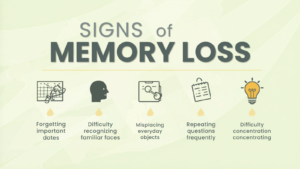
The following signs are based on the Alzheimer’s Association’s 10 warning signs of Alzheimer’s and dementia, and the 2025 TIAA Institute research brief on eight early signs of cognitive decline. If you notice several of these — particularly in combination — a medical evaluation is warranted.
- Memory Loss That Disrupts Daily Life
This is the most recognized warning sign, but it is frequently misunderstood.
The key phrase is disrupts daily life. Forgetting a recent conversation occasionally is not the sign. Asking the same question multiple times in the same conversation — with no memory of having asked it — is.
A person in the early stages of Alzheimer’s may remember a childhood birthday clearly but be unable to recall what they had for breakfast or that they just spoke to their daughter an hour ago.
- Difficulty Planning or Solving Problems
This sign is subtler and often missed.
Early cognitive decline frequently shows up as difficulty following a familiar recipe, managing a monthly budget, or tracking bills. These are tasks that require holding multiple pieces of information in working memory simultaneously — an ability that is specifically affected early in the progression of dementia.
The person knows what they are trying to do. They simply cannot execute the steps reliably anymore.
- Confusion With Time or Place
Losing track of dates, seasons, or how much time has passed is a specific warning sign.
A senior with early dementia may forget what year it is, be unable to recall what day of the week it is consistently, or become confused about where they are — including in familiar locations they have visited for decades.
This is distinct from normal disorientation after waking from a deep sleep or after travel across time zones.
- Trouble With Words — Speaking or Writing
Everyone occasionally struggles to find the right word. But a specific early sign of dementia is stopping in the middle of a conversation with no ability to continue, calling objects by the wrong name (calling a watch a hand-clock), or having noticeable difficulty following a conversation.
The Alzheimer’s Association also notes that difficulty repeating oneself — saying the same phrase or story multiple times in the same conversation — is a distinct warning sign.
- Getting Lost in Familiar Places
AARP and the Ohio State University Medical Center both list worsening spatial and directional sense as an early cognitive warning sign.
This manifests as difficulty driving a familiar route, getting confused in a well-known neighborhood, or struggling to follow written directions.
It is different from occasionally making a wrong turn. It is a consistent pattern of confusion in spaces that should be automatic.
- Poor Judgment or Decision-Making
The Johns Hopkins Bloomberg School of Public Health found that adults with dementia exhibit financial symptoms up to six years before a formal diagnosis.
Early cognitive decline impairs judgment in ways that show up as susceptibility to financial scams, making large unusual purchases, giving away money inappropriately, or neglecting personal hygiene and grooming in ways that were previously uncharacteristic.
- Withdrawal From Social Activities
A senior in early cognitive decline may begin pulling away from hobbies, social events, and activities they previously enjoyed. This is not simply introversion or tiredness.
It is often driven by the anxiety of not being able to follow conversations, fear of making visible mistakes, or general confusion that makes social settings feel overwhelming.
- Changes in Mood and Personality
The Alzheimer’s Association notes that changes in mood and personality can be early warning signs, including becoming confused, suspicious, depressed, fearful, or anxious in ways that represent a notable change from baseline.
A 2023 study in the Journal of Alzheimer’s Disease found that apathy — a loss of motivation, interest, and engagement — may signal progression from mild cognitive impairment to Alzheimer’s disease.
- Difficulty Completing Familiar Tasks
This goes beyond learning new things. A person with early dementia may have trouble completing tasks they have done thousands of times: driving to a known destination, operating a familiar appliance, or following through on a routine they have maintained for years.
- Changes in Sleep Behavior
AARP notes that certain sleep behaviors — such as acting out dreams physically, talking during sleep, or sleepwalking when this was not previously the case — can be associated with specific types of dementia, particularly Lewy body dementia.
Research published by the American Women’s Medical Association found that a 1 percent reduction in deep sleep per year for people over 60 is associated with a 27 percent increased risk of developing dementia and a 32 percent increased risk of Alzheimer’s disease.
What Is Mild Cognitive Impairment — And Is It Dementia?
Between normal aging and dementia, there is a middle stage called mild cognitive impairment, or MCI.
MCI produces memory and thinking changes that are noticeable — to the person and often to those around them — but do not yet seriously interfere with daily functioning.
People with MCI are more likely to develop Alzheimer’s or another dementia than those without it. But MCI does not inevitably progress. Some people with MCI stay stable for years. Some improve. Only a minority progress to dementia within five years.
The importance of identifying MCI is that it represents the window where lifestyle intervention has the greatest potential impact — before significant brain damage has occurred.
What Causes Memory Loss in Seniors — Not Always Dementia
This is a critical point that is frequently overlooked.
Many causes of memory loss in older adults are fully reversible. Before assuming the worst, a doctor should evaluate for:
- Depression — one of the most common and most overlooked causes of memory problems in older adults. Depression impairs concentration and memory significantly and responds well to treatment.
- Thyroid disorders — an underactive thyroid (hypothyroidism) causes cognitive slowing, memory problems, and mental fog that closely mimic early dementia. A simple blood test identifies it.
- Medication side effects — many medications commonly prescribed to seniors affect memory and cognition, including certain sleep aids, antihistamines, bladder medications, and some blood pressure drugs.
- Sleep deprivation and sleep apnea — poor sleep impairs memory consolidation and directly accelerates cognitive decline. Sleep apnea is significantly underdiagnosed in seniors.
- Nutritional deficiencies — vitamin B12 deficiency causes cognitive symptoms that look identical to early dementia and is common in older adults, particularly those on metformin or proton pump inhibitors.
- Dehydration — even mild dehydration impairs concentration and short-term memory in older adults, whose thirst mechanism is less reliable.
- Chronic stress and anxiety — elevated cortisol from chronic stress directly damages the hippocampus, the brain structure most involved in forming new memories.
Always get a full medical evaluation before attributing memory changes to dementia. Many people have had their quality of life dramatically improved simply by treating one of these reversible causes.
The 5 Lifestyle Factors That Reduce Dementia Risk
This is where the news is genuinely encouraging.
Evidence-based lifestyle interventions — not medications — are the most effective tools currently available for reducing the risk of cognitive decline and dementia. A 2025 UCLA Health report confirmed that adults who followed a structured program of healthy eating, physical activity, cognitive engagement, social engagement, and cardiovascular health monitoring experienced significantly slower cognitive decline.
- Exercise — The Most Protective Intervention Available
Physical activity has the strongest evidence base of any single lifestyle intervention for brain health.
Aerobic exercise increases blood flow to the brain, stimulates production of brain-derived neurotrophic factor (BDNF) which supports the growth and maintenance of brain cells, and directly reduces the amyloid plaques associated with Alzheimer’s disease.
A 2025 meta-analysis of 37 studies found that resistance training had the strongest effect on cognitive function of any exercise type in older adults. Zone 2 cardio walking also consistently reduces dementia risk in large cohort studies. Even 6,000 to 7,000 daily steps is associated with a 60 percent reduction in subjective cognitive decline.
The AMWA Brain Health guide recommends at least 150 minutes per week of moderate exercise plus two resistance training sessions.
- The MIND Diet
The MIND diet — a hybrid of the Mediterranean and DASH diets — is specifically designed for brain health and has the strongest evidence for reducing Alzheimer’s risk of any dietary pattern studied.
It emphasizes leafy green vegetables, berries, whole grains, fish, beans, nuts, and olive oil, while limiting red meat, butter, cheese, and sweets. These foods overlap almost entirely with the anti-inflammatory dietary pattern and the 5 daily longevity foods that senior health research consistently supports.
Omega-3 fatty acids from fatty fish are particularly important — research shows that combinations of omega-3s with other nutritional components can reduce cognitive decline and delay dementia onset.
- Sleep — The Brain’s Cleaning System
During deep sleep, the brain’s glymphatic system flushes out amyloid beta — the protein that accumulates into the plaques associated with Alzheimer’s disease.
Poor sleep directly increases amyloid burden in the brain. The AMWA data found that every 1 percent reduction in deep sleep per year after 60 is associated with a 27 percent higher risk of dementia. Seven to eight hours of consistent sleep is not a luxury — it is a brain health intervention.
The daily habits that compound into major health gains all reinforce the sleep consistency that protects the brain.
- Social Engagement
Social isolation is an independent risk factor for cognitive decline and dementia — comparable in effect size to physical inactivity. Regular social engagement keeps the prefrontal cortex active, builds cognitive reserve, and reduces the depression and anxiety that are themselves memory-impairing.
- Cardiovascular Health
Vascular dementia — the second most common type of dementia after Alzheimer’s — results directly from damage to blood vessels that supply the brain. Controlling blood pressure, maintaining healthy cholesterol, avoiding smoking, and managing diabetes are all direct brain protection strategies.
Every lifestyle change that protects the heart protects the brain. The longevity habits that keep seniors healthy into their 80s are doing double duty — they are simultaneously the most effective cognitive protection available.
When to See a Doctor
Do not wait until the symptoms are severe.
Early evaluation matters for two reasons.
First, many causes of memory loss are reversible — and the sooner they are identified and treated, the better the outcome.
Second, if early-stage dementia is present, earlier intervention with lifestyle modification, cognitive exercises, and emerging medications produces better outcomes than waiting until function has significantly declined.
See a doctor if you notice:
- Memory problems that are getting progressively worse over months
- Difficulty completing tasks that were previously routine
- Getting lost in familiar places more than once
- Personality or mood changes that are noticeably different from baseline
- Family members or close friends expressing concern
- Difficulty managing finances, medications, or daily schedules
The Alzheimer’s Association helpline is available 24 hours a day, 7 days a week at 800-272-3900 for anyone who wants to talk through concerns before or after a medical visit.
Frequently Asked Questions
What is the first sign of memory loss in seniors?
The most recognized early sign is forgetting recently learned information repeatedly — not occasionally, but as a consistent pattern. Asking the same question multiple times in the same conversation without any memory of having asked it is one of the most specific early warning signs of Alzheimer’s disease, according to the Alzheimer’s Association.
Is forgetting names a sign of dementia?
Occasionally forgetting a name but remembering it later — especially with a clue or reminder — is normal aging. Consistently forgetting the names of close family members or friends, or having the name simply never return even with prompts, is a warning sign worth discussing with a doctor.
At what age does memory loss become a concern?
Memory loss can occur at any age and can have many causes. Age-related memory impairment becomes more common after 65. What matters more than age is the pattern: is the forgetting getting progressively worse? Is it interfering with daily life? Is it happening in combination with other warning signs? These questions are more meaningful than a specific age.
Can memory loss be reversed in seniors?
In many cases, yes — when the underlying cause is treatable. Depression, thyroid disorders, vitamin B12 deficiency, medication side effects, sleep apnea, and dehydration can all cause memory problems that resolve fully with treatment. Even in early-stage dementia, lifestyle interventions including regular aerobic and resistance exercise, the MIND diet, and consistent sleep have been shown to slow progression significantly.
What is the difference between normal forgetting and dementia?
Normal forgetting: temporary, returns with a reminder, does not disrupt daily function. Dementia: persistent, does not return with reminders, progressively worsens, and begins to interfere with daily activities, work, relationships, and independence. The Washington University School of Medicine summarizes it as: the degree of impairment is the key difference.
Does exercise really reduce the risk of dementia?
Yes — physical activity has the strongest evidence base of any single lifestyle intervention for brain health. A 2025 meta-analysis found resistance training had the strongest effect on cognitive function of any exercise type in older adults. Aerobic activity improves cerebral blood flow and reduces amyloid plaque buildup. Even daily walking at 6,000–7,000 steps is associated with significantly lower cognitive decline risk.
What foods protect against memory loss?
The MIND diet — emphasizing leafy green vegetables, berries (blueberries especially), fatty fish, whole grains, nuts, beans, and olive oil — has the strongest research base for reducing Alzheimer’s risk. These foods reduce brain inflammation, support vascular health, and provide the omega-3 fatty acids and antioxidants that protect brain cells. They overlap closely with the anti-inflammatory diet for seniors and the 5 daily longevity foods that senior health research consistently supports.
Conclusion
Most memory changes after 60 are normal. The brain slows. Word retrieval takes a beat longer. You walk into rooms and forget why.
But there are specific signs that go beyond this — persistent memory loss that disrupts daily life, confusion with time and place, difficulty completing familiar tasks, and personality changes that represent a noticeable shift.
If those signs are present, get a medical evaluation early. Many causes are reversible. And where early cognitive decline is genuine, the lifestyle changes that protect the brain are the same ones that protect everything else — consistent daily movement, quality sleep, the MIND and anti-inflammatory dietary pattern, and the compounding daily habits that research consistently links to a longer, healthier, sharper life.
The brain responds to the same inputs as the body. Take care of one and you take care of both.